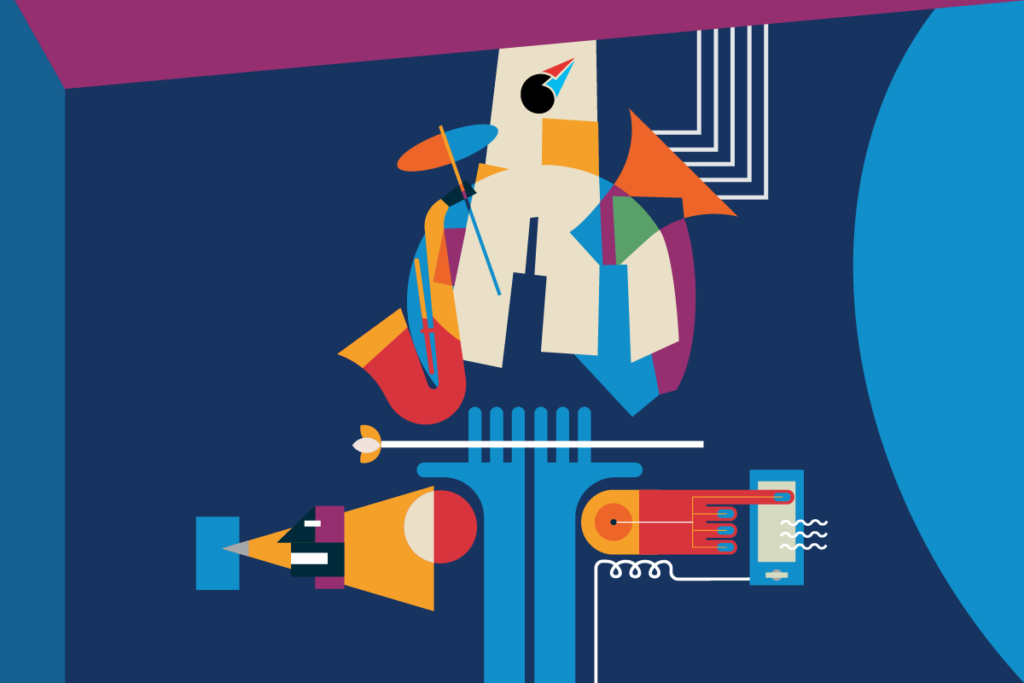
The Orchestrator: Redefining the Marketer in the Age of Artificial Intelligence
The tools now play on their own. So who decides what the brand sounds like?
Ιn 1955, in an episode of the CBS television programme Omnibus, Leonard Bernstein conducted the opening bars of Brahms’s First Symphony and then, at some point, simply stepped down from the podium. The orchestra kept playing as if nothing had happened. And he turned to the camera and asked: “If the orchestra can manage on its own, what exactly does the conductor do?”
More than seventy years later, the same question applies to marketing. AI tools collect data, predict behaviour, allocate budgets, optimise campaigns and answer customers, often with no one on the podium. They work. But nobody buys a ticket just to hear the notes; they buy it for an interpretation they will remember.
Up to the 18th century, an orchestra was guided by one of its own musicians, who played his own part at the same time. From Beethoven’s era onwards, as orchestras grew and works became more complex, a person who played no instrument but devoted himself to listening to and coordinating the whole ensemble came to be seen as indispensable. That was the conductor, as we know him today.
Something similar is now true of marketing. Dozens of applications, among them CRMs, advertising platforms and AI tools, run in parallel, yet the chatbot may not know what the CRM is predicting, social listening does not feed back into strategy, and dashboards fill up with disconnected numbers. In the literature, this situation is known as technological fragmentation: companies adopt AI tools without a clear strategic direction. The result is more noise, not better music.
Our team builds strategy with P.R. Smith’s SOSTAC® method, one of the most widely used strategic planning models: situation analysis, objectives, strategy, tactics, actions, control. It is clear, practical and proven, but it has one limit: it moves in a straight line. In markets that change every week, by the time we reach the final step of control, we risk the original analysis having already become outdated. With artificial intelligence, the line in strategy can become a circle. It becomes a feedback loop in which the results of control return to the analysis in real time, objectives become dynamic, predictive KPIs come into play, and each stage draws on the appropriate “form” of AI. “Mechanical AI” takes on data collection and pattern detection in the analysis, “Thinking AI” the forecasting that underpins objectives and strategy, and “Feeling AI” the tactics and actions, where the emotions of the audience matter.

In this system, the human is not retreating; the human is changing roles. According to Bernstein, the conductor’s instrument is a hundred human instruments, and his job, which is enormously broad, is to make them sound like one. That is why he must be a master of technique, possess a vast body of knowledge, have a deep grasp of the inner meaning of the composition, and be a strong communicator. If we put the brand in place of the music, the description fits today’s marketer almost word for word, whose “instrument” is both human and digital: teams, data, platforms, algorithms.
The marketer becomes a strategic orchestrator: deciding which tool takes on what, as an orchestrator assigns musical phrases to the instruments, and monitoring the result in real time, as a conductor does during the concert. The machine suggests based on patterns; the human brings context, empathy and ethical judgment, and makes the decision. Even when AI checks whether the tactics actually meet the objectives and whether the plan is feasible with the available resources, it continues to operate within the boundaries set by the human.
None of this means less work for people; it simply means different work. Automation makes sense when it frees people from mechanical tasks, giving them time for creativity, a deeper understanding of the audience, and continuous learning. In addition, since data often carries the biases of the conditions in which it was created, and the same technology that serves a customer can also manipulate them, ethics has become a safety switch.
In the CBS excerpt, Bernstein distinguishes performances that are “dry as dust” from those full of passion, and concludes that the ideal is a combination of the two. That is also the essence of marketing in the age of artificial intelligence: the precision of the machine together with the judgment and ethical thinking of the human. The tools are now the same for everyone; what makes a brand unique is the orchestration.
This article is based on an episode of the CBS television programme Omnibus featuring Leonard Bernstein, and on the master’s thesis of Chryssa Stavridou titled: Application of Artificial Intelligence and Machine Learning Techniques for the Evolution of the SOSTAC® Method in Modern Digital Marketing: A Conceptual AI-Driven Strategic Synthesis Framework (ADSSF).
Master’s thesis